Part IV: Complex Systems
17. Competition and Cooperation
Read the opening pages · printed page 281
The Spatial Prisoner's Dilemma (sipd.c (and eipd.c))
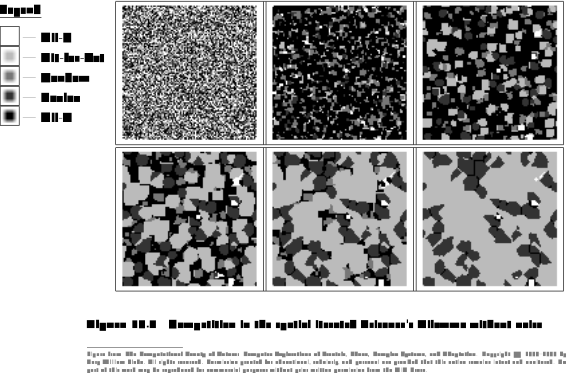
Every cell on the grid plays the iterated Prisoner's Dilemma against its eight neighbors using one of five strategies (always cooperate, always defect, random, tit-for-tat, Pavlov), then copies whichever neighbor scored best. Cooperators survive by clustering; defectors invade the clusters and then starve. A little noise keeps the map churning between tit-for-tat and Pavlov with blooms of defection. Full screen →
Sections
- Game Theory and Zero-Sum Games
- Nonzero-Sum Games and Dilemmas
- Iterated Prisoner's Dilemma
- Stable Strategies and Other Considerations
- Ecological and Spatial Worlds
- Final Thoughts
- Further Exploration
- Further Reading