Part II: Fractals
5. Self-Similarity and Fractal Geometry
Read the opening pages · printed page 61
Diffusion-Limited Aggregation (diffuse.c)
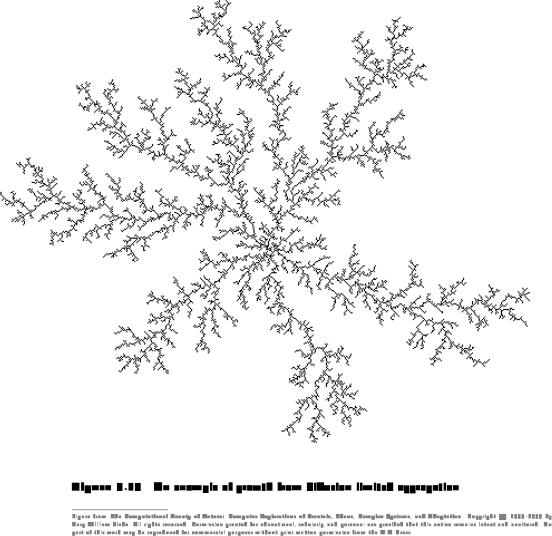
Particles wander at random until they touch the growing cluster, then freeze. Because a wandering particle is far more likely to bump into a tip than to find its way into a crevice, the cluster grows branches, and the branches grow branches. The result has a fractional dimension of about 1.7, the same as coral, frost, and electrical discharge. Runs alternate between one seed, several seeds, and a line seed along the bottom that grows a forest. Full screen →
Sections
- The Cantor Set
- The Koch Curve
- The Peano Curve
- Fractional Dimensions
- Random Fractals in Nature and Brownian Motion
- Further Exploration
- Further Reading